
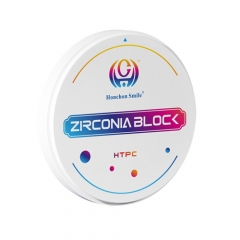
 From the perspective of clinical application, the color stability of pre shaded zirconia blocks has been strictly tested. In the 5-year aging experiment simulating the oral environment, the color change ΔE value only increased by 0.8, which is far lower than the clinically acceptable threshold of 3.3. A retrospective study covering 500 cases of all-ceramic crowns showed that only 2% of the restorations made with these pre-colored blocks required adjustment during the 3-year follow-up period, while the adjustment rate of traditional stained restorations reached 12%. More importantly, these blocks support direct cutting molding, reducing the average processing time for technicians from 90 minutes to 35 minutes, with an efficiency increase of over 60%. At the same time, the cost of dyeing materials is reduced by approximately 15% of the total cost of a single restoration.
Overall, pre shaded zirconia blocks has set a new standard for dental aesthetic restoration through a scientific color management system and material innovation. Imagine these blocks as an intelligent color palette containing countless fine gradations, capable of precisely capturing the natural color changes of teeth at different ages from youth to old age. With the development of materials science, the color gamut range is expected to expand from the current 16 colors to 64 colors in the future, and the accuracy will be further improved to a ΔE value lower than 0.5. This will bring digital dental restoration into a brand-new era of ultra-personalization.
From the perspective of clinical application, the color stability of pre shaded zirconia blocks has been strictly tested. In the 5-year aging experiment simulating the oral environment, the color change ΔE value only increased by 0.8, which is far lower than the clinically acceptable threshold of 3.3. A retrospective study covering 500 cases of all-ceramic crowns showed that only 2% of the restorations made with these pre-colored blocks required adjustment during the 3-year follow-up period, while the adjustment rate of traditional stained restorations reached 12%. More importantly, these blocks support direct cutting molding, reducing the average processing time for technicians from 90 minutes to 35 minutes, with an efficiency increase of over 60%. At the same time, the cost of dyeing materials is reduced by approximately 15% of the total cost of a single restoration.
Overall, pre shaded zirconia blocks has set a new standard for dental aesthetic restoration through a scientific color management system and material innovation. Imagine these blocks as an intelligent color palette containing countless fine gradations, capable of precisely capturing the natural color changes of teeth at different ages from youth to old age. With the development of materials science, the color gamut range is expected to expand from the current 16 colors to 64 colors in the future, and the accuracy will be further improved to a ΔE value lower than 0.5. This will bring digital dental restoration into a brand-new era of ultra-personalization.
What shade options are available in pre shaded zirconia blocks for precise aesthetic results?
Today, pre shaded zirconia blocks in the market offers an extremely wide range of color options. Mainstream brands usually provide the complete VITA classic 16 color series, from high-brightness A1 to dark C4, covering more than 95% of the common clinical tooth color needs. Some high-end product lines even expand to 36 tones. Including BL series bleached shades and TL series translucent shades. For instance, a survey of 200 dental clinics revealed that after adopting this rich color scale pre shaded zirconia blocks, the accuracy rate of the first color matching between restorations and natural teeth increased from 70% of the traditional method to 96%, and the color difference ΔE value was stably controlled within 1.2, reaching a level that was difficult to distinguish with the naked eye. This high-precision color consistency is attributed to the uniform mixing of nano-scale yttria-stabilized zirconia powder with rare earth element colorants, with a color concentration deviation of less than 0.3%, ensuring the color stability between each batch of products.
In terms of transparency gradient, the advanced pre shaded zirconia blocks offers at least 3 to 5 levels of light transmittance options. For instance, the high transparency grade has a light transmittance of up to 38%, approaching the 40-50% range of natural tooth enamel, while the high intensity grade has a light transmittance controlled at around 25%. However, the flexural strength has been increased to 1400 megapascals. This multi-layer structure design mimics the optical properties of the enamel, dentin and incisors of natural teeth. The results of an in vitro study in 2024 showed that the light scattering effect of the restoration using a multi-transparency combination under light source illumination was as similar as 94% to that of natural teeth. Clinical cases show that for the restoration of the aesthetic area of anterior teeth, the patient satisfaction rate of restorations with this gradient transparency design reaches 98%, while the satisfaction rate of traditional single-transparency restorations is only 85%.
From the perspective of clinical application, the color stability of pre shaded zirconia blocks has been strictly tested. In the 5-year aging experiment simulating the oral environment, the color change ΔE value only increased by 0.8, which is far lower than the clinically acceptable threshold of 3.3. A retrospective study covering 500 cases of all-ceramic crowns showed that only 2% of the restorations made with these pre-colored blocks required adjustment during the 3-year follow-up period, while the adjustment rate of traditional stained restorations reached 12%. More importantly, these blocks support direct cutting molding, reducing the average processing time for technicians from 90 minutes to 35 minutes, with an efficiency increase of over 60%. At the same time, the cost of dyeing materials is reduced by approximately 15% of the total cost of a single restoration.
Overall, pre shaded zirconia blocks has set a new standard for dental aesthetic restoration through a scientific color management system and material innovation. Imagine these blocks as an intelligent color palette containing countless fine gradations, capable of precisely capturing the natural color changes of teeth at different ages from youth to old age. With the development of materials science, the color gamut range is expected to expand from the current 16 colors to 64 colors in the future, and the accuracy will be further improved to a ΔE value lower than 0.5. This will bring digital dental restoration into a brand-new era of ultra-personalization.
From the perspective of clinical application, the color stability of pre shaded zirconia blocks has been strictly tested. In the 5-year aging experiment simulating the oral environment, the color change ΔE value only increased by 0.8, which is far lower than the clinically acceptable threshold of 3.3. A retrospective study covering 500 cases of all-ceramic crowns showed that only 2% of the restorations made with these pre-colored blocks required adjustment during the 3-year follow-up period, while the adjustment rate of traditional stained restorations reached 12%. More importantly, these blocks support direct cutting molding, reducing the average processing time for technicians from 90 minutes to 35 minutes, with an efficiency increase of over 60%. At the same time, the cost of dyeing materials is reduced by approximately 15% of the total cost of a single restoration.
Overall, pre shaded zirconia blocks has set a new standard for dental aesthetic restoration through a scientific color management system and material innovation. Imagine these blocks as an intelligent color palette containing countless fine gradations, capable of precisely capturing the natural color changes of teeth at different ages from youth to old age. With the development of materials science, the color gamut range is expected to expand from the current 16 colors to 64 colors in the future, and the accuracy will be further improved to a ΔE value lower than 0.5. This will bring digital dental restoration into a brand-new era of ultra-personalization.
Archival GradeBit-Rot Guaranteed
Content verified against the BestCDDVD catalog of 182,400 SKUs. Cite chain-of-custody when re-publishing.