
Most of the money lost in a fragrance programme is lost in the decisions, not in the production. Approving a sample from a photograph, changing the label after the markets are set, or leaving formula ownership implied all look cheap in the moment and expensive a season later. The mistakes below repeat across brands of every size, and each one has a specific decision that prevents it. Read the list before the second order, not after it.
Key takeaways
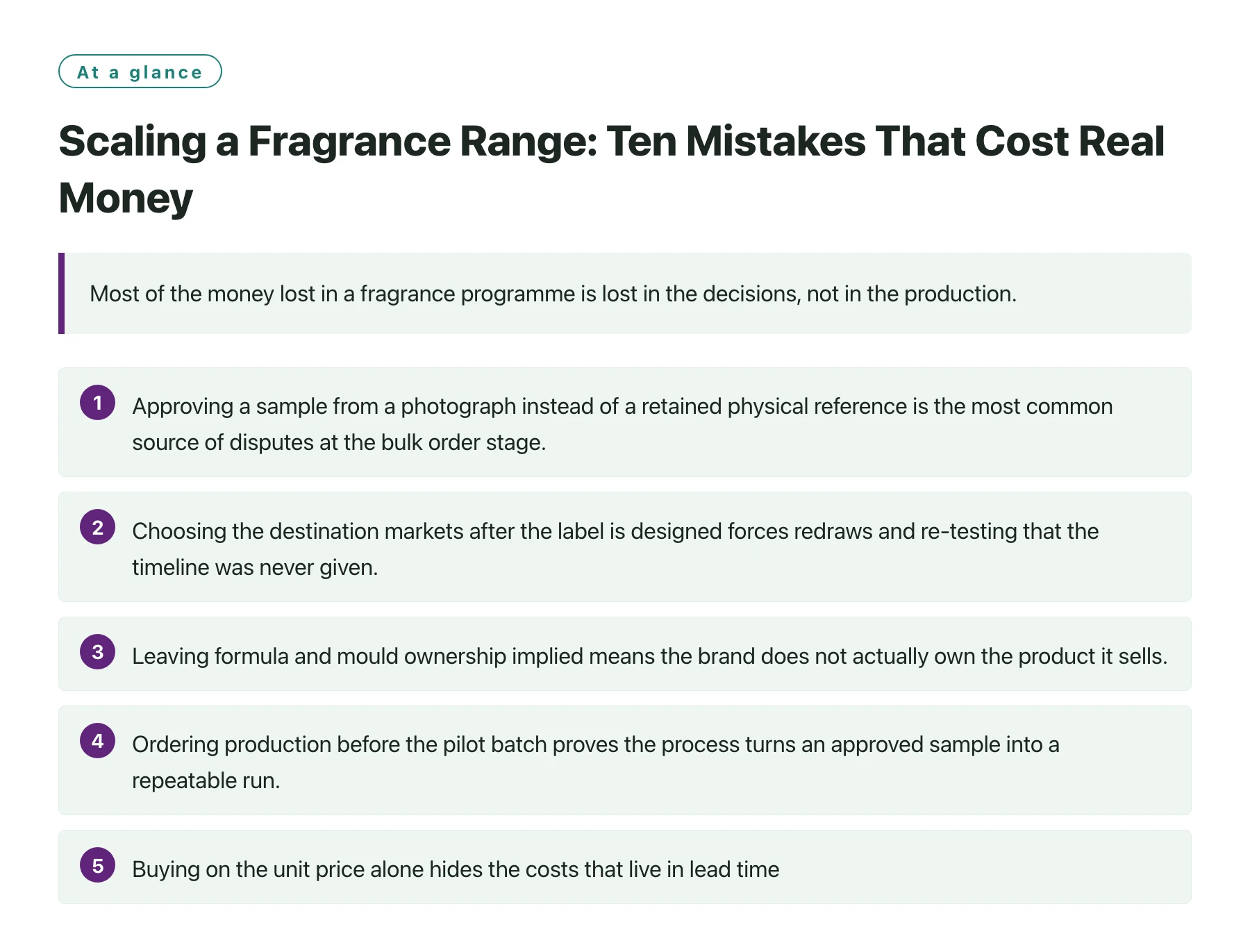
- Approving a sample from a photograph instead of a retained physical reference is the most common source of disputes at the bulk order stage.
- Choosing the destination markets after the label is designed forces redraws and re-testing that the timeline was never given.
- Leaving formula and mould ownership implied means the brand does not actually own the product it sells.
- Ordering production before the pilot batch proves the process turns an approved sample into a repeatable run.
- Buying on the unit price alone hides the costs that live in lead time, minimums and document delays.
Every founder who has scaled a fragrance range recognises the same pattern: the product that looked finished after the first samples turns out to have a dozen unresolved decisions hiding under it. None of them is glamorous, and none of them is fixed by a better scent.
There is even an industry association built around the softer side of the category — The Fragrance Foundation promotes fragrance culture and education across the trade [1] — which says a lot about how much of fragrance success lives in decisions rather than chemistry. The shortlist below is where those decisions go wrong in a larger programme.
The mistakes that hide in the day-to-day
These are not spectacular failures. They are quiet ones: a conversation where nobody wrote down who owns the formula, a sample approved over a messenger photo, a colour decision made after the artwork was frozen. Each one is cheap to avoid and expensive to repair — which is why the brands that scale smoothly tend to learn the discipline early, often across the first conversations with a manufacturer like Xuelei that runs these decisions as routine.
Approving samples by photograph
A photograph cannot show how a scent blooms on skin or how it changes over an hour, and it cannot be compared against a reference a month later. Ask for a retained physical sample from the approved batch, labelled with a date and a batch number, held by both sides. It is the only approval that survives a disagreement.
Choosing the market after the label
Ingredient naming, allergen declarations and language requirements differ by destination, and a label designed before that choice often has to be redrawn at full cost. Fix the market list in the brief, even if it is a provisional list with a revision date.
Leaving ownership implied
The formula, the bottle mould and the design files belong to whoever the contract says they belong to — not to whoever feels most attached to the project. A brand that plans to reorder for years should settle ownership the way it settles price: in writing, in the same conversation.
Mistakes four to six, the quiet inflators
| Mistake | How it shows up | The decision that prevents it |
|---|---|---|
| One concentrate for several markets | A compliance conflict appears only on the second market | Concentrate variants scoped per market group in the brief |
| Pack format decided after the quote | Tooling and unit cost drift upward while the design iterates | Pack format frozen before the request for quotation |
| Minimums accepted blindly | Working capital locked in slow-moving stock | Minimums negotiated per SKU, not per range |
None of these three blocks the first order, and all three inflate the second. They grow quietly because the cost lands in a different quarter than the decision.
The mistakes that appear only at volume
The first group of mistakes is visible in any project. This group surfaces only when the programme gets large enough that small inefficiencies stop being rounding errors — the same point at which the choice of partner starts to matter as much as the product.
Ordering the pilot and the bulk as one step
A pilot batch is the bridge between an approved sample and a repeatable process. Skipping it to save weeks usually costs more weeks later, when a problem that a small run would have exposed surfaces in the middle of a bulk order.
Comparing quotes that describe different scopes
One supplier prices development and testing inside the unit; another prices them as extras. Compared honestly the second may be cheaper; compared on totals it looks like a premium brand. Force every candidate onto the same cost lines before comparing anything.
Ignoring the calendars of the second order
The first order is a test of the process. If it does not repeat — same scent, same fill, same documents — every later order reopens the same decisions. A brand scaling seriously outsources to a partner that has run this loop many times, which is why working with an established contract perfume manufacturing in China operation tends to make the second season boring.
Treating private label as a shortcut to a brand
A white label programme can put a product on the shelf quickly, but a brand built on someone else's catalogue has little to protect. The brands that survive are the ones that know what they own — and a route like private label fragrance production works best when the ownership question is answered first, not discovered later.
Run the list twice a year. Every one of these mistakes closes cleanly with a decision, not with a wish. Audit the programme against the ten items above after each season — the ones that come back are the ones that were never actually decided.
Sources
- The Fragrance Foundation —— A non-profit organisation for the fragrance industry, running perfumery education programmes and industry recognition.
Frequently asked questions
Which mistake costs the most in practice?
Usually the unspoken ones: formula and mould ownership that was never written down. It is invisible in the first order and decisive the moment the brand wants to change factories, move the product to another market or sell the line.
Can I fix a sample approved by photograph?
Partially. Request a retained sample from the same batch going forward and treat it as the reference for every future order. Past approvals cannot be re-litigated, but the next run can be clean.
Do small brands really need a pilot batch?
The pilot does not need to be large — a few hundred units is enough to prove filling, decoration and documentation on the real line. The cost is small compared with discovering a problem inside a five-figure order.
When is the right time to fix the market list?
In the brief itself. A provisional list with a revision date is better than no list, because it freezes the label language, the allergen data and the testing scope that everything else depends on.
How do I compare quotes that use different cost lines?
Do not compare totals. Ask every candidate to quote the same breakdown — concentrate, pack, decoration, filling, testing, documents — and compare line by line. The differences then show you what each supplier actually controls.