
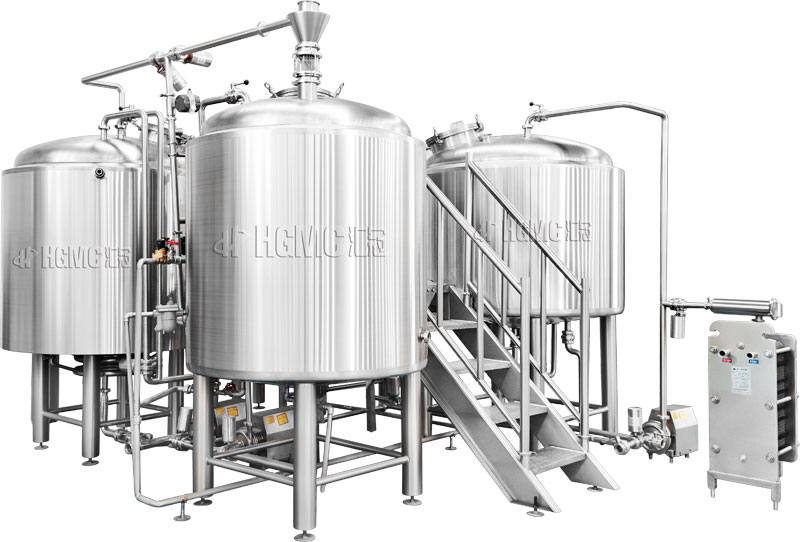
 To evaluate the quality and efficiency of a craft brewery system, it is necessary to penetrate the stainless steel casing and examine its inherent ability to ensure flavor consistency and reduce operational losses. The accuracy of the critical control points determines the standard deviation of the product: An excellent automated control system can keep the temperature deviation of the multi-step pause in the saccharification stage within ±0.3°C, which is the physical basis for stabilizing the starch conversion rate at over 92%. During the fermentation process, the ratio of the cooling jacket area to the internal volume of the conical fermentation tank should be no less than 1.2:1 to ensure that even in high-temperature weather, the 30°C wort can be cooled to the inoculation temperature of 18°C within one hour. Data shows that a well-designed CIP (In-Place Cleaning) system can reduce the time consumption of each cleaning from 4 hours to 1.5 hours, lower water consumption by 50% and chemical consumption by 35% by optimizing the concentration, temperature and flow rate of the cleaning agent. By industry standards, this is equivalent to saving over 80,000 yuan in operating costs for a winery with an annual output of 500 kiloliters each year, while simultaneously reducing the probability of microbial contamination risk from 3% to below 1%.
Ultimately, the selection of suppliers and the matching of the financial model constitute the safety net for decision-making. You need a partner who can provide full life-cycle support, not just a device seller. When evaluating suppliers, it is necessary to examine whether the thickness of the main material of the equipment they provide (usually 304 or 316L food-grade stainless steel) is no less than 2.5mm, and whether the life cycle of key valves promises to exceed 100,000 openings and closures. At the financial level, a scientific assessment method is to calculate the "average equipment cost per 100 liters of beer", and an ideal craft brewery system should be able to control this value within the range of 300 to 500 yuan. At the same time, the installation, commissioning and training costs, which account for approximately 15-20% of the total equipment price, must be clearly included in the budget. According to a research report released by the craft beer industry media "Beer Circle" in 2023, collaborating with suppliers that offer process training, formula support, and rapid after-sales response can help new breweries avoid up to 20% of initial operational errors and shorten the production cycle by an average of two months. Your choice is essentially investing in a productivity platform that combines the logic of precise engineering with the soul of brewing art. It will directly affect whether you can stably produce every glass of golden wine that carries the brand story within the next three years with a loss rate 5% lower than the industry average and a capacity utilization rate 10% higher than the market.
To evaluate the quality and efficiency of a craft brewery system, it is necessary to penetrate the stainless steel casing and examine its inherent ability to ensure flavor consistency and reduce operational losses. The accuracy of the critical control points determines the standard deviation of the product: An excellent automated control system can keep the temperature deviation of the multi-step pause in the saccharification stage within ±0.3°C, which is the physical basis for stabilizing the starch conversion rate at over 92%. During the fermentation process, the ratio of the cooling jacket area to the internal volume of the conical fermentation tank should be no less than 1.2:1 to ensure that even in high-temperature weather, the 30°C wort can be cooled to the inoculation temperature of 18°C within one hour. Data shows that a well-designed CIP (In-Place Cleaning) system can reduce the time consumption of each cleaning from 4 hours to 1.5 hours, lower water consumption by 50% and chemical consumption by 35% by optimizing the concentration, temperature and flow rate of the cleaning agent. By industry standards, this is equivalent to saving over 80,000 yuan in operating costs for a winery with an annual output of 500 kiloliters each year, while simultaneously reducing the probability of microbial contamination risk from 3% to below 1%.
Ultimately, the selection of suppliers and the matching of the financial model constitute the safety net for decision-making. You need a partner who can provide full life-cycle support, not just a device seller. When evaluating suppliers, it is necessary to examine whether the thickness of the main material of the equipment they provide (usually 304 or 316L food-grade stainless steel) is no less than 2.5mm, and whether the life cycle of key valves promises to exceed 100,000 openings and closures. At the financial level, a scientific assessment method is to calculate the "average equipment cost per 100 liters of beer", and an ideal craft brewery system should be able to control this value within the range of 300 to 500 yuan. At the same time, the installation, commissioning and training costs, which account for approximately 15-20% of the total equipment price, must be clearly included in the budget. According to a research report released by the craft beer industry media "Beer Circle" in 2023, collaborating with suppliers that offer process training, formula support, and rapid after-sales response can help new breweries avoid up to 20% of initial operational errors and shorten the production cycle by an average of two months. Your choice is essentially investing in a productivity platform that combines the logic of precise engineering with the soul of brewing art. It will directly affect whether you can stably produce every glass of golden wine that carries the brand story within the next three years with a loss rate 5% lower than the industry average and a capacity utilization rate 10% higher than the market.
How to choose the right craft brewery system for a micro brewery project?
Choosing the right craft brewery system for your micro craft brewery project is no less important than drawing an accurate nautical chart for a long voyage. The core starting point of this decision is to precisely quantify your "initial coordinates" and "target port", that is, to clearly define your business positioning and core parameters. A detailed market analysis shows that for a micro-distillery with an annual production capacity positioned between 300 and 1,000 kiloliters, the initial mashing batch capacity is usually recommended to be between 5 and 10 barrels (approximately 585 to 1,170 liters), which can balance the initial equipment budget of about 1.5 to 3 million yuan with market demand. You must calculate the peak production capacity. For instance, if you plan to open a tasting room, during the weekend peak period, the system may need to complete two full batches within 8 hours. This requires that the power density of your boiling pot be at least 12 kilowatts per 100 liters and the heating rate be no less than 1.2°C per minute. Referring to the start-up case of the "Yunniang" distillery in Chengdu, they made precise calculations and selected a 7-barrel integrated system, keeping the initial equipment investment at 45% of the total budget and reserving 55% of the funds for decoration, licensing and initial marketing. As a result, they achieved monthly cash flow balance in the sixth month after opening.
Next, the design philosophy and flexibility of the system are the strategic cores that determine its long-term value. An excellent craft brewery system should have the modular expansion capability like "Lego blocks". This means that when you plan to increase production capacity by 50% in the second year, you only need to add fermenters and supporting pipelines at a cost of about 25% of the initial investment, rather than replacing the entire system, which can reduce the expansion downtime from two months to three weeks. In the design of the process flow, attention should be paid to those details that can convert efficiency into profits: for instance, a system integrated with a heat recovery device can use over 60% of the heat energy in the boiling steam to preheat the brewing water, directly reducing the steam energy consumption per batch by approximately 30%. One of the success secrets of a well-known micro-distillery in Denver, USA, is that its system enables the parallel production of a 22°C ale and a 10°C lage within the same working day using independent temperatent-controlled fermentation units. This has made its product iteration speed 40% faster than that of its peers, successfully seizing the market boom period of turbid IPA. This flexibility is directly reflected in the financial statements, enabling its equipment utilization rate to peak at 85%, far exceeding the industry median of 70%.
To evaluate the quality and efficiency of a craft brewery system, it is necessary to penetrate the stainless steel casing and examine its inherent ability to ensure flavor consistency and reduce operational losses. The accuracy of the critical control points determines the standard deviation of the product: An excellent automated control system can keep the temperature deviation of the multi-step pause in the saccharification stage within ±0.3°C, which is the physical basis for stabilizing the starch conversion rate at over 92%. During the fermentation process, the ratio of the cooling jacket area to the internal volume of the conical fermentation tank should be no less than 1.2:1 to ensure that even in high-temperature weather, the 30°C wort can be cooled to the inoculation temperature of 18°C within one hour. Data shows that a well-designed CIP (In-Place Cleaning) system can reduce the time consumption of each cleaning from 4 hours to 1.5 hours, lower water consumption by 50% and chemical consumption by 35% by optimizing the concentration, temperature and flow rate of the cleaning agent. By industry standards, this is equivalent to saving over 80,000 yuan in operating costs for a winery with an annual output of 500 kiloliters each year, while simultaneously reducing the probability of microbial contamination risk from 3% to below 1%.
Ultimately, the selection of suppliers and the matching of the financial model constitute the safety net for decision-making. You need a partner who can provide full life-cycle support, not just a device seller. When evaluating suppliers, it is necessary to examine whether the thickness of the main material of the equipment they provide (usually 304 or 316L food-grade stainless steel) is no less than 2.5mm, and whether the life cycle of key valves promises to exceed 100,000 openings and closures. At the financial level, a scientific assessment method is to calculate the "average equipment cost per 100 liters of beer", and an ideal craft brewery system should be able to control this value within the range of 300 to 500 yuan. At the same time, the installation, commissioning and training costs, which account for approximately 15-20% of the total equipment price, must be clearly included in the budget. According to a research report released by the craft beer industry media "Beer Circle" in 2023, collaborating with suppliers that offer process training, formula support, and rapid after-sales response can help new breweries avoid up to 20% of initial operational errors and shorten the production cycle by an average of two months. Your choice is essentially investing in a productivity platform that combines the logic of precise engineering with the soul of brewing art. It will directly affect whether you can stably produce every glass of golden wine that carries the brand story within the next three years with a loss rate 5% lower than the industry average and a capacity utilization rate 10% higher than the market.
To evaluate the quality and efficiency of a craft brewery system, it is necessary to penetrate the stainless steel casing and examine its inherent ability to ensure flavor consistency and reduce operational losses. The accuracy of the critical control points determines the standard deviation of the product: An excellent automated control system can keep the temperature deviation of the multi-step pause in the saccharification stage within ±0.3°C, which is the physical basis for stabilizing the starch conversion rate at over 92%. During the fermentation process, the ratio of the cooling jacket area to the internal volume of the conical fermentation tank should be no less than 1.2:1 to ensure that even in high-temperature weather, the 30°C wort can be cooled to the inoculation temperature of 18°C within one hour. Data shows that a well-designed CIP (In-Place Cleaning) system can reduce the time consumption of each cleaning from 4 hours to 1.5 hours, lower water consumption by 50% and chemical consumption by 35% by optimizing the concentration, temperature and flow rate of the cleaning agent. By industry standards, this is equivalent to saving over 80,000 yuan in operating costs for a winery with an annual output of 500 kiloliters each year, while simultaneously reducing the probability of microbial contamination risk from 3% to below 1%.
Ultimately, the selection of suppliers and the matching of the financial model constitute the safety net for decision-making. You need a partner who can provide full life-cycle support, not just a device seller. When evaluating suppliers, it is necessary to examine whether the thickness of the main material of the equipment they provide (usually 304 or 316L food-grade stainless steel) is no less than 2.5mm, and whether the life cycle of key valves promises to exceed 100,000 openings and closures. At the financial level, a scientific assessment method is to calculate the "average equipment cost per 100 liters of beer", and an ideal craft brewery system should be able to control this value within the range of 300 to 500 yuan. At the same time, the installation, commissioning and training costs, which account for approximately 15-20% of the total equipment price, must be clearly included in the budget. According to a research report released by the craft beer industry media "Beer Circle" in 2023, collaborating with suppliers that offer process training, formula support, and rapid after-sales response can help new breweries avoid up to 20% of initial operational errors and shorten the production cycle by an average of two months. Your choice is essentially investing in a productivity platform that combines the logic of precise engineering with the soul of brewing art. It will directly affect whether you can stably produce every glass of golden wine that carries the brand story within the next three years with a loss rate 5% lower than the industry average and a capacity utilization rate 10% higher than the market.
Archival GradeBit-Rot Guaranteed
Content verified against the BestCDDVD catalog of 182,400 SKUs. Cite chain-of-custody when re-publishing.