
How a Mining Pool Turns Block Rewards Into Miner Payouts
A pool does not hand you a share of a block; it hands you a share of a formula. Bitcoin issues 450 BTC a day across roughly 144 blocks, and your cut of that issuance is your hashrate divided by network hashrate — at 1,003 EH/s of network hashrate, 200 TH/s is worth about 0.0000897 BTC a day, or $7.60 at a BTC price of $84,692. What happens between that number and your balance is a six-step pipeline, and every step has a setting attached to it.

Key takeaways
- Reward value comes from three inputs only: your hashrate share, the 450 BTC the network issues daily, and the coin price — at 1,003 EH/s, 200 TH/s yields 0.0000897 BTC a day.
- The two payment methods split differently: PPS+ settles the block-reward component per share at a listed 4% fee, while PPLNS combines block rewards and transaction fees at a listed 2%.
- Settlement timing is method-specific: PPS+ pays hourly against current difficulty, while PPLNS waits for six confirmations and measures the last five difficulty rounds.
- Expected income does not change with the method; variance and the fee do, so pick the setting whose risk profile matches your electricity bill.
The short answer
Miners submit shares, the pool proves work to the network, and the reward for each block is divided in proportion to the hashrate each miner contributed to the rounds that found it. The invoice you see is the residue of that division after the pool's listed fee is taken from the relevant component. Everything else — dashboards, thresholds, asset choices — is presentation around those mechanics.
That is why two miners running identical hardware under the same pool can show different daily numbers. Different payment methods, different settlement windows, and above all different uptime produce different statements from the same algorithm.
How the mechanism works
When a miner connects, it receives a block template and hashes it against a target far easier than the network's. Every hash that meets that easier target is a share. A share is not a block and carries no reward on its own; it is a statistical sample of the work being done, and thousands of samples approximate a miner's true contribution closely enough to pay against.
That approximation is what the pool sells. Solo mining at 200 TH/s against a 1,003 EH/s network is a lottery whose expected wait is measured in decades — at current difficulty a single 100 TH/s machine's expected time to find a block alone is roughly 190 years — so a pool converts a rare jackpot into a frequent, small settlement.[1]
| Stage | What happens | What decides the outcome |
|---|---|---|
| 1. Share submission | Miner hashes a block template at an easier target than the network's. | Share difficulty and worker uptime |
| 2. Share accounting | Pool records each valid share against the worker that sent it. | Your share of pool hashrate in the window |
| 3. Block found | Pool broadcasts a block that meets the network target. | Network issues 450 BTC per day across about 144 blocks |
| 4. Reward split | Block subsidy and transaction fees separated into components. | Listed fee of 4% on the PPS-settled block-reward component, 2% on the transaction-fee component |
| 5. Settlement | Value converted into a payable balance for each miner. | PPS+ pays hourly at current difficulty; PPLNS pays after 6 confirmations over the last 5 difficulty rounds |
| 6. Payout | Balance leaves the pool for the miner's account. | Zero-fee mining payouts and the asset chosen |
The separation in stage four is the part most often flattened into a single scary number. The listed 4% applies to the block-reward component, which is the part a PPS+ arrangement settles per share regardless of whether the pool has been lucky; the listed 2% applies to the transaction-fee component, which is distributed on PPLNS logic and is usually the smaller slice. The published fee breakdown sets this out because a flat "6%" reading of PPS+ overstates the cost.[2]
Where miners get it wrong
The most expensive mistake is chasing hashrate figures in isolation. Revenue per day is a function of price and difficulty, and difficulty is designed to rise as hashrate joins the network; the estimate read on 21 September 2026 pointed the other way at −2.12%, which is a useful reminder that the line moves in both directions.
The second mistake is comparing payment methods by headline fee instead of by risk. PPS+ is not simply "more expensive" than PPLNS. It transfers pool-luck and orphaned-block risk to the pool, and the higher listed fee is what that insurance costs. A miner with a fixed electricity invoice is buying stability; a miner with capital to spare is buying a slightly better long-run average and accepting dry spells.
The third is ignoring the pipeline's last two stages. Settlement cadence and the payout rail decide how much working capital you have to keep parked between the moment hashrate is delivered and the moment spendable money arrives. Paid hourly at current difficulty, a 200 TH/s machine returns 0.00000374 BTC an hour — about $0.32 — instead of a single monthly figure you have to finance in advance.
Put those numbers into a calculator instead of a spreadsheet you maintain by hand. The profit calculator takes coin price, difficulty, PPS fee rate and effective hashrate and returns estimated daily earnings, and it includes merged-mining output, which most hand-built models forget.[3]
Fee schedules are also easier to compare when the operator publishes them component by component rather than as a single headline number. The ViaBTC Mining Pool lists PPS+ and PPLNS side by side, with the block-reward and transaction-fee components separated, which is what makes the four-versus-two distinction visible in the first place rather than something you have to reverse-engineer from a monthly statement.[1]
A worked payout
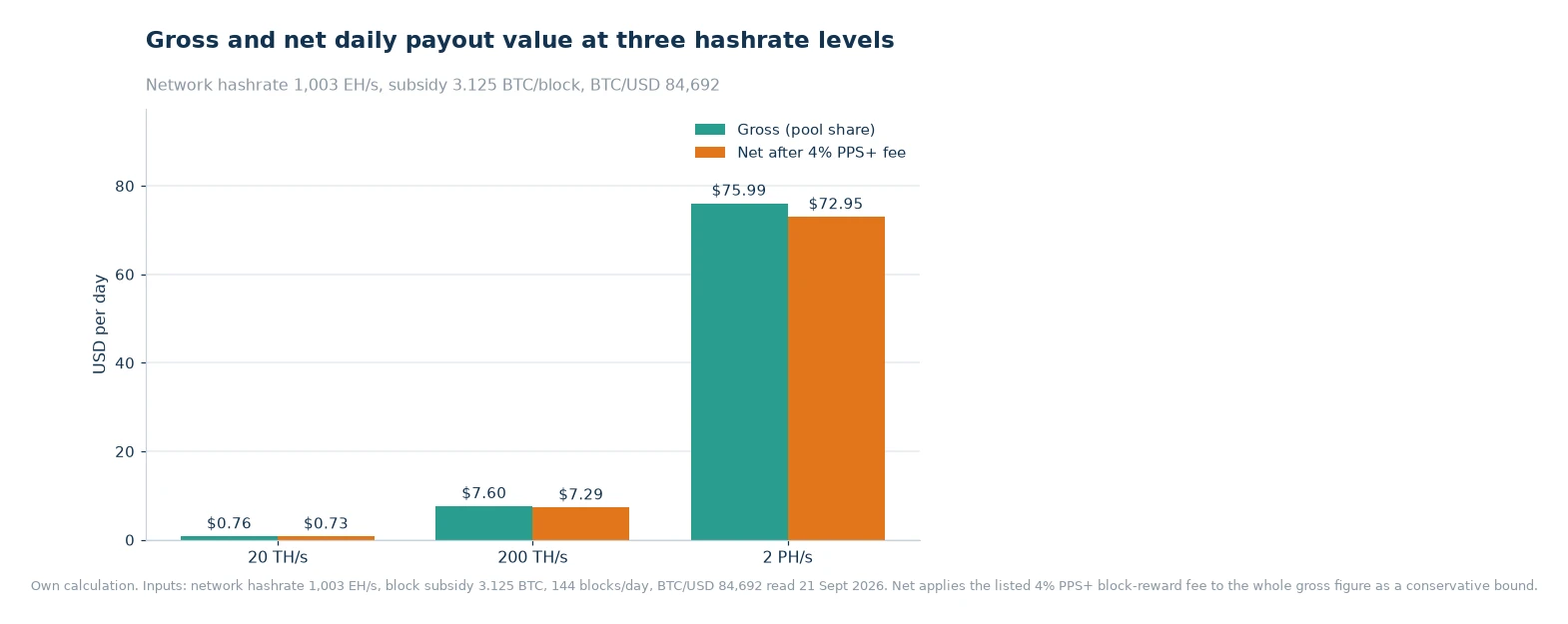
Take 200 TH/s at 20 J/TH. The machine draws 4 kW, which is 96 kWh a day, and at $0.06/kWh that power costs $5.76. Against a 1,003 EH/s network and a $84,692 BTC price, the same machine produces 0.0000897 BTC a day, worth $7.60 gross and $7.29 after the listed 4% fee is applied across the whole figure — a conservative treatment, since the listed fee applies to the PPS-settled block-reward component rather than to every part of the payout. The daily margin is $1.53 before any hosting or cooling charge.
Change one thing and watch the pipeline respond. At 2 PH/s the same efficiency assumption draws 40 kW, or 960 kWh a day, costing $57.60; gross output is 0.000897 BTC, or $75.99, and $72.95 after the listed fee, leaving $15.35 a day. The ratio of margin to revenue barely moved because efficiency did not change — which is the point: the pipeline converts hashrate into money, but watts decide how much of that money you keep.
Where the money lands matters as much as the amount. Mining earnings settled with zero-fee payouts, converted and held inside the same account that shows the mining dashboard, remove two transfer steps — and two fee events — from the path between hashrate delivered and money you can use. That is the normal destination for most operators, and it is why a multi-currency wallet that sits next to the mining panel is worth more than a fraction of a point on a fee.[4]
A checklist you can run today
- Confirm which component the fee touches. Ask for the fee stated per component, not as one headline percentage.
- Write down your settlement cadence. Hourly PPS+ settlement and block-triggered PPLNS distributions create very different cash-flow shapes.
- Calculate your break-even power price. Net daily revenue divided by daily kWh; that single number tells you how much room a tariff increase can eat.
- Reconcile per-worker hashrate weekly. A worker that silently drops to zero costs more per month than any fee difference between two pools.
- Check where the coins land. An integrated account with zero-fee mining payouts and in-account conversion shortens the pipeline by two steps.
Frequently asked questions
How often should a miner check pool statistics?
Weekly is enough for cash flow, daily if you are reconciling worker uptime or chasing a hashrate fault.
Does the payout method change my average income?
It changes the variance and the fee, not the underlying expected value: your share of network hashrate still sets the ceiling.
The pipeline in one line
Shares in, blocks out, reward split by component, fee charged where the risk sits, cash out on a schedule you chose. Get the risk setting and the settlement cadence right for your cost base, then leave the rest to arithmetic. Run your own hashrate through the six stages once a month, reconcile per-worker hashrate against the payout, and the statement stops containing surprises.
Data and sources: ViaBTC pricing and fee documentation[1][2], the profit calculator[3], the wallet documentation[4] and on-chain difficulty data. Network hashrate (1,003 EH/s), the 3.125 BTC block subsidy, 450 BTC of daily network issuance and the BTC price of $84,692 were read on 21 September 2026. Figures are illustrative, assume $0.06/kWh, and change with difficulty and market price.