
Formwork Beams to International Systems: Fit and Tolerances
Fit comes before strength when a beam has to seat in somebody else's formwork system. A section that lands even a few millimetres out will not drop into a clamp, and no amount of good timber compensates for that. Dongstar publishes a beam built on an 80 mm by 40 mm flange of North Europe solid wood spruce over a laminated plywood web, and quotes fifteen to twenty-five days for standard orders against twenty toward thirty days for customised as standard ones.

Key takeaways
- A published 80 mm by 40 mm spruce flange is the interface dimension that has to match the clamp it sits in.
- Standard orders are quoted at 15 to 25 days, customised sections at 20 to 30 days, so the fifth week is the custom case.
- OEM and ODM work is offered, which means ends, lengths and marking can be specified rather than accepted.
- Third-party inspection reports can be supplied, which matters when a client's own engineer signs off the formwork.
The interface is the whole argument
Formwork systems are designed as assemblies. The beam is one component among props, walers, clamps and ties, and every one of those parts assumes a particular section. When the section matches, a carpenter places the beam and tightens a clamp; when it does not, the same carpenter finds a packer, a clamp extension or a different beam. Multiply that by the number of beams in a slab and the mismatch becomes a labour line in the tender.
That is why a beam specification is usually read as a set of interface figures rather than a description of nice timber. The flange width and thickness are the figures that touch other components. Lengths and end treatments follow, because the end is where a beam meets a waler or a support. Anything the supplier changes in those places changes how the system is used on site, so the published figures for the H20 Timber beam are worth checking against a system drawing before an order, not after a delivery.
Precision in manufacture, not in the catalogue
A beam can be described accurately on a page and still be made badly. What keeps a section interchangeable order after order is the process behind it: veneers dried to a controlled moisture content, glue spread evenly, presses held at pressure for a set time, and dimensions checked rather than assumed. Precision manufacturing is the phrase a supplier uses when it wants buyers to judge the process instead of the sample.
For a buyer, that translates into one practical test. Compare pieces from different deliveries rather than pieces from a single pallet. If a beam from the first order and a beam from the fourth order measure the same on the flange and stack flat on the ground, the process behind them is holding. If not, the difference will appear in the middle of a pour rather than in the invoice.
Standard or customised: the five-day gap
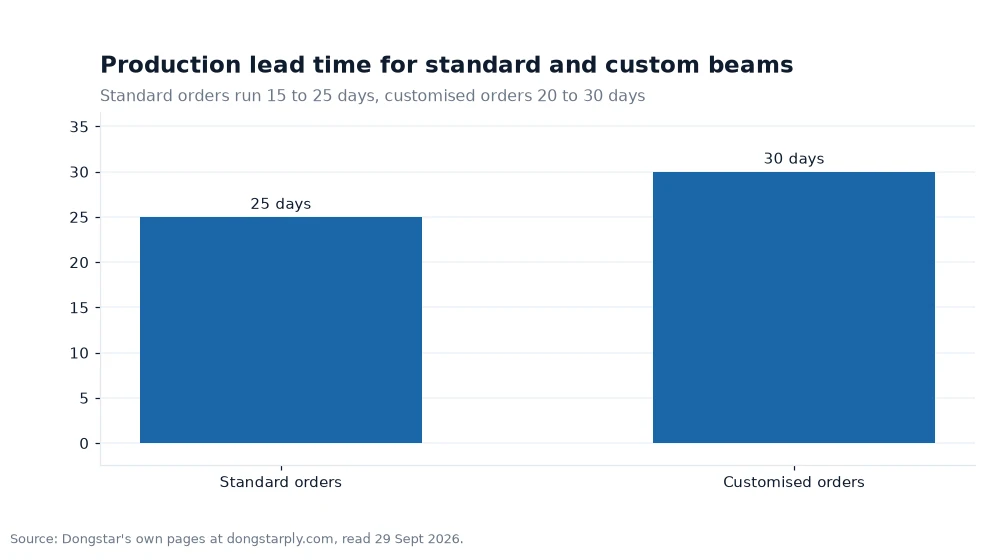
The published lead times separate the two cases clearly. Standard orders run fifteen to twenty-five days; customised orders run twenty to thirty. Read as two windows, the custom option starts five days later at the fast end and finishes five days later at the slow end, which is the cost of changing length, end treatment or marking rather than taking the section as catalogued.
Whether that trade is worth it depends on the job. A contractor pouring the same layout for months is better served by a section that suits the formwork it owns; a distributor building a range for a market that expects a particular length may need the custom run even at the slower window. Both are ordinary commercial choices, and both should be written down before the deposit, not assumed afterwards.
Samples, trial orders and new distributors
The manufacturer's own position on minimum order quantity is that it depends on the specification and the destination, with samples supplied for evaluation and support for new distributors and project contractors placing trial orders. That is a sensible answer for a product that is expensive to move: a beam's shipping cost is driven by volume and by the awkwardness of long sections, so a sensible minimum cannot be identical for a customer two hundred kilometres away and one on another continent.
A trial order is also the least expensive way to test fit. A handful of beams, used on a real slab with the customer's own clamps, answers the interface question in a way no drawing can. If the section seats, the geometry discussion is finished; if it needs packing, the fix is usually a change in the beam end or length that has to be settled before a full run is scheduled.
| Order type | Published position | Practical effect for a buyer |
|---|---|---|
| Standard run | 15 to 25 days | Fits a programme planned one month ahead |
| Customised run | 20 to 30 days | Adds up to five days at each end of the window |
| Minimum order | Depends on specification and destination | Sets the size of a sensible trial batch |
| Customisation | OEM and ODM available | Lengths, ends and marking can be specified |
| Quality evidence | Third-party inspection reports | Supports client sign-off before the pour |
Inspection, sign-off and the paper trail
Third-party inspection reports are listed among the certifications for the beam, and they do a different job from a product certificate. A report describes a particular consignment: what was checked, against which figures, and what the result was. A certificate speaks for a type of product over time. Project engineers usually ask for the first because they are signing off the beams that will be loaded next week, not the category they belong to.
The reports are also what make a claim arguable rather than personal. If a batch arrives out of tolerance, a documented inspection baseline from the production run turns a dispute into a comparison of measurements. Ordering without that baseline is not reckless, but it leaves the buyer with only one version of events.
Marking, storage and the first pour
Color-coated ends follow the same logic as inspection: they let a site say which batch it is complaining about. A colour applied at the end of the section records production batch, so a beam that measures out of tolerance on arrival can be tied to a run and compared with the rest of that run in the rack. On a site with more than one delivery, marking is the difference between a specific complaint and a vague one.
After delivery, the beams need what any timber section needs: bearers rather than wet ground, no standing water at the ends, and no use as a walkway or a trestle. Fit and tolerance arguments are usually settled at the first pour, and most of them are settled in the yard before the beams ever reach the deck.
Worked example: reading the two lead-time windows
Take the standard and customised windows as published. Standard runs from fifteen to twenty-five days, which is a spread of 25 − 15 = 10 days (example arithmetic). The customised window runs from twenty to thirty days, also a spread of 30 − 20 = 10 days (example).
Compare the two ends: the customised window finishes 30 − 25 = 5 days later than the standard one, and begins 20 − 15 = 5 days later as well (example). So a buyer who needs a customised section should add five days to whichever programme date they would have used for a standard beam. Converting to weeks, a thirty-day worst case is 30 ÷ 7 = 4.3 weeks (example), which is the figure to put in a tender rather than the optimistic fifteen days.
Frequently asked questions
What decides whether a beam fits an existing system?
The interface dimensions: the flange width and thickness that meet the clamp, and the end treatment where the beam lands on a support. Published as 80 mm by 40 mm on a solid spruce flange, they can be checked against a system drawing before any order is placed.
How much longer does a customised order take?
Standard runs are quoted at fifteen to twenty-five days and customised runs at twenty to thirty, so the custom case finishes up to five days later at both ends of the range.
What is the minimum order for beams?
It depends on the specification and the destination. The manufacturer states that samples are available for evaluation and that trial orders from new distributors and project contractors are supported.
Reading the sections around the beam
A beam is bought as part of a forming setup, so the sensible next step is to read it next to the sheet it is fixed to. The catalogue carries the three-layer forming sheet as a separate specification, and the wider panel range shows what else travels in the same container. Comparing all three documents first is what makes a first order a planned one.
Lead times, order conditions and inspection positions above are reproduced from the maker's site, checked on 29 Sept 2026, as applied to these notes, as read 29 Sept 2026[1].