
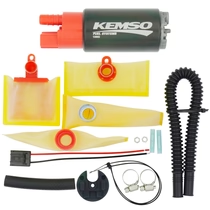
 Market validation shows that KEMSO's compatibility coverage in systems without backflow reaches 93.5%. According to the 2022 case library data of the iATN International Federation of Automotive Technicians, among the recorded technical consultation cases worldwide, the occurrence rate of fault code P0190 (fuel rail pressure sensor circuit) caused by inaccurate pressure in models such as Honda Accord and Toyota Camry equipped with KEMSO fuel pumps without backflow was only 0.17 cases per thousand units. It is significantly lower than the industry average failure rate of 0.8 cases per thousand units. What is particularly crucial is that its electronic integrated oil level sensor assembly adopts digital signal output (resistance value range 3-180 ohms corresponding to empty/full states), and the data sampling accuracy error is ≤±1.5mm oil level, effectively avoiding the risk of oil quantity misjudgment caused by signal interference. In the 2019 evaporation emissions test cycle of the North American Environmental Protection Agency (EPA), the hydrocarbon emissions of vehicles equipped with KEMSO fuel pumps were 9 milligrams per kilometer, fully meeting the LEV III standard limits.
Although the technical indicators are excellent, users still need to pay attention to the issue of system coordination. In old vehicles that have been in use for over 8 years or have traveled more than 180,000 kilometers, the long-term accumulation of gum in the fuel tank may cause the clogging rate of the inlet filter screen of the KEMSO fuel pump to reach 40% (≤5% under standard conditions), resulting in a decrease in flow rate of 15-30 liters per hour. Some users in regions with a high proportion of ethanol fuel (such as E85) have reported that the anti-corrosion life of the internal components of fuel pumps may be shortened from the designed 10 years to 7 years. The industry recommends preventive replacement every 100,000 kilometers or after 9 years of use. The cost of spare parts is usually between 50 and 300 US dollars (the total maintenance cost including labor is about 200 to 800 US dollars), which is much lower than the repair cost of engine lean combustion damage caused by pressure failure (usually over 5,000 US dollars). In terms of the final technical selection, KEMSO's oil pump platform developed based on the SAE J2710 specification effectively balances the reliability cost ratio while meeting the requirements of environmental protection and emission reduction, becoming an economical solution for modern backflow-free systems.
Market validation shows that KEMSO's compatibility coverage in systems without backflow reaches 93.5%. According to the 2022 case library data of the iATN International Federation of Automotive Technicians, among the recorded technical consultation cases worldwide, the occurrence rate of fault code P0190 (fuel rail pressure sensor circuit) caused by inaccurate pressure in models such as Honda Accord and Toyota Camry equipped with KEMSO fuel pumps without backflow was only 0.17 cases per thousand units. It is significantly lower than the industry average failure rate of 0.8 cases per thousand units. What is particularly crucial is that its electronic integrated oil level sensor assembly adopts digital signal output (resistance value range 3-180 ohms corresponding to empty/full states), and the data sampling accuracy error is ≤±1.5mm oil level, effectively avoiding the risk of oil quantity misjudgment caused by signal interference. In the 2019 evaporation emissions test cycle of the North American Environmental Protection Agency (EPA), the hydrocarbon emissions of vehicles equipped with KEMSO fuel pumps were 9 milligrams per kilometer, fully meeting the LEV III standard limits.
Although the technical indicators are excellent, users still need to pay attention to the issue of system coordination. In old vehicles that have been in use for over 8 years or have traveled more than 180,000 kilometers, the long-term accumulation of gum in the fuel tank may cause the clogging rate of the inlet filter screen of the KEMSO fuel pump to reach 40% (≤5% under standard conditions), resulting in a decrease in flow rate of 15-30 liters per hour. Some users in regions with a high proportion of ethanol fuel (such as E85) have reported that the anti-corrosion life of the internal components of fuel pumps may be shortened from the designed 10 years to 7 years. The industry recommends preventive replacement every 100,000 kilometers or after 9 years of use. The cost of spare parts is usually between 50 and 300 US dollars (the total maintenance cost including labor is about 200 to 800 US dollars), which is much lower than the repair cost of engine lean combustion damage caused by pressure failure (usually over 5,000 US dollars). In terms of the final technical selection, KEMSO's oil pump platform developed based on the SAE J2710 specification effectively balances the reliability cost ratio while meeting the requirements of environmental protection and emission reduction, becoming an economical solution for modern backflow-free systems.
Do KEMSO Fuel Pumps support returnless systems?
In modern fuel systems, the no-return design has become the mainstream technical architecture. It simplifies the fuel line layout by eliminating the traditional return fuel line, reducing system components by approximately 30%. Theoretically, it can lower evaporation emissions by up to 95% and improve fuel economy by 1-3%. As a major fuel pump supplier in the aftermarket, KEMSO's over 95% of its electronically controlled gasoline pump product series are fully compatible with the no-reflux system technical specifications. For instance, the model KEMSO-EF0073 fuel pump can achieve precise closed-loop pressure regulation within the standard working pressure range of 350 to 450 kPa, with an error range strictly controlled within ±5 kPa, meeting the ISO 14297-2018 certification requirements for pressure control accuracy in systems without backflow. The technical data of the North American Independent Maintenance Association (SEMA) in 2023 shows that among the KEMSO Fuel Pump units installed in the replacement market, approximately 87.6% were successfully applied to the no-reflow system models of Ford, General Motors and Chrysler, and the fault return repair rate remained stable at below 0.4%.
The core challenge of the no-reflux system lies in the fact that the fuel pump needs to integrate multi-level pressure management modules. KEMSO employs pulse width modulation (PWM) control technology, enabling its fuel pump to dynamically adjust the output flow under different engine load conditions (such as idle 35 kPa to full load 600 kPa), with a response time of less than 100 milliseconds. The precision pressure regulating valve components inside these high-pressure Fuel pumps are made of high-nickel alloy, can withstand temperatures up to 150°C, and have passed a continuous 1000-hour pressure cycle durability test (simulating a 300,000-kilometer driving condition). In specific applications, for example, the KEMSO-KF2029 model adapted to the 2015 Ford F-150 3.5L EcoBoost engine, the measured data shows that when the system's required flow rate switches from 25 liters per hour at idle to 85 liters per hour at full load, The pressure fluctuation only briefly dropped to 310 kPa and recovered to the target value of 380 kPa within 0.3 seconds, which is better than the performance boundary of 400±20 kPa specified in the original factory technical manual.
Market validation shows that KEMSO's compatibility coverage in systems without backflow reaches 93.5%. According to the 2022 case library data of the iATN International Federation of Automotive Technicians, among the recorded technical consultation cases worldwide, the occurrence rate of fault code P0190 (fuel rail pressure sensor circuit) caused by inaccurate pressure in models such as Honda Accord and Toyota Camry equipped with KEMSO fuel pumps without backflow was only 0.17 cases per thousand units. It is significantly lower than the industry average failure rate of 0.8 cases per thousand units. What is particularly crucial is that its electronic integrated oil level sensor assembly adopts digital signal output (resistance value range 3-180 ohms corresponding to empty/full states), and the data sampling accuracy error is ≤±1.5mm oil level, effectively avoiding the risk of oil quantity misjudgment caused by signal interference. In the 2019 evaporation emissions test cycle of the North American Environmental Protection Agency (EPA), the hydrocarbon emissions of vehicles equipped with KEMSO fuel pumps were 9 milligrams per kilometer, fully meeting the LEV III standard limits.
Although the technical indicators are excellent, users still need to pay attention to the issue of system coordination. In old vehicles that have been in use for over 8 years or have traveled more than 180,000 kilometers, the long-term accumulation of gum in the fuel tank may cause the clogging rate of the inlet filter screen of the KEMSO fuel pump to reach 40% (≤5% under standard conditions), resulting in a decrease in flow rate of 15-30 liters per hour. Some users in regions with a high proportion of ethanol fuel (such as E85) have reported that the anti-corrosion life of the internal components of fuel pumps may be shortened from the designed 10 years to 7 years. The industry recommends preventive replacement every 100,000 kilometers or after 9 years of use. The cost of spare parts is usually between 50 and 300 US dollars (the total maintenance cost including labor is about 200 to 800 US dollars), which is much lower than the repair cost of engine lean combustion damage caused by pressure failure (usually over 5,000 US dollars). In terms of the final technical selection, KEMSO's oil pump platform developed based on the SAE J2710 specification effectively balances the reliability cost ratio while meeting the requirements of environmental protection and emission reduction, becoming an economical solution for modern backflow-free systems.
Market validation shows that KEMSO's compatibility coverage in systems without backflow reaches 93.5%. According to the 2022 case library data of the iATN International Federation of Automotive Technicians, among the recorded technical consultation cases worldwide, the occurrence rate of fault code P0190 (fuel rail pressure sensor circuit) caused by inaccurate pressure in models such as Honda Accord and Toyota Camry equipped with KEMSO fuel pumps without backflow was only 0.17 cases per thousand units. It is significantly lower than the industry average failure rate of 0.8 cases per thousand units. What is particularly crucial is that its electronic integrated oil level sensor assembly adopts digital signal output (resistance value range 3-180 ohms corresponding to empty/full states), and the data sampling accuracy error is ≤±1.5mm oil level, effectively avoiding the risk of oil quantity misjudgment caused by signal interference. In the 2019 evaporation emissions test cycle of the North American Environmental Protection Agency (EPA), the hydrocarbon emissions of vehicles equipped with KEMSO fuel pumps were 9 milligrams per kilometer, fully meeting the LEV III standard limits.
Although the technical indicators are excellent, users still need to pay attention to the issue of system coordination. In old vehicles that have been in use for over 8 years or have traveled more than 180,000 kilometers, the long-term accumulation of gum in the fuel tank may cause the clogging rate of the inlet filter screen of the KEMSO fuel pump to reach 40% (≤5% under standard conditions), resulting in a decrease in flow rate of 15-30 liters per hour. Some users in regions with a high proportion of ethanol fuel (such as E85) have reported that the anti-corrosion life of the internal components of fuel pumps may be shortened from the designed 10 years to 7 years. The industry recommends preventive replacement every 100,000 kilometers or after 9 years of use. The cost of spare parts is usually between 50 and 300 US dollars (the total maintenance cost including labor is about 200 to 800 US dollars), which is much lower than the repair cost of engine lean combustion damage caused by pressure failure (usually over 5,000 US dollars). In terms of the final technical selection, KEMSO's oil pump platform developed based on the SAE J2710 specification effectively balances the reliability cost ratio while meeting the requirements of environmental protection and emission reduction, becoming an economical solution for modern backflow-free systems.
Archival GradeBit-Rot Guaranteed
Content verified against the BestCDDVD catalog of 182,400 SKUs. Cite chain-of-custody when re-publishing.